In today’s tech-first world, businesses need tailor-made computerized solutions—software that superbly adjusts to their workflows, clients, and future objectives. That’s why custom programming is booming.
But here’s the catch: while a custom software program can give you a massive edge, it’s also a tricky landscape. One wrong move and your dream project can become a digital disaster—delays, budget blowouts, unusable interfaces, or worse, starting all over again.
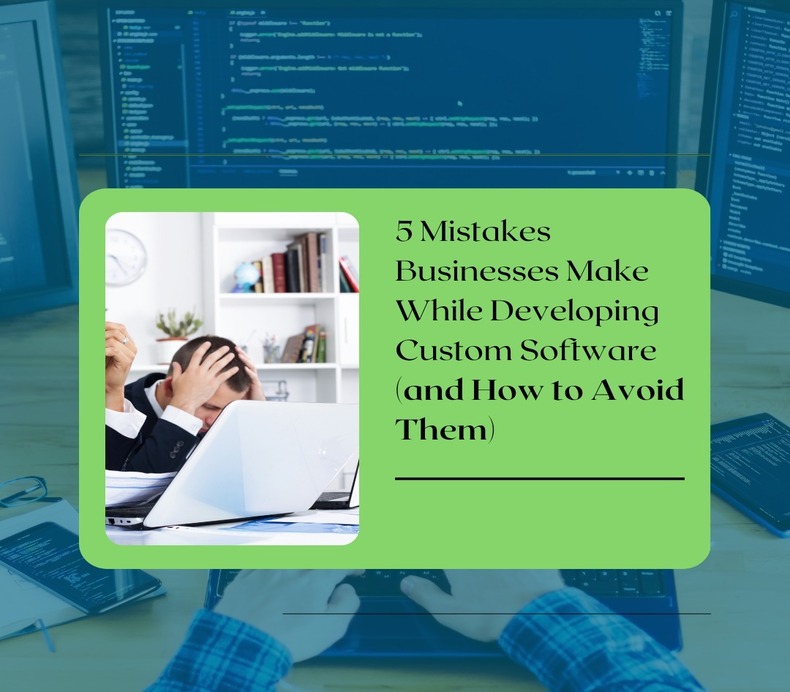
To spare you from that nightmare, here are five common mistakes businesses make while creating custom software and how to dodge each one like a pro:
1. Skipping the planning stage and jumping into development 🚫
The mistake:
Imagine building a house without a blueprint. Sounds crazy, right? Yet many businesses do that with software. They rush into development without clearly understanding what they need, who the users are, and what outcomes they expect.
✅ The fix:
Start with clarity. Define:
- Your goals, scope, and success metrics
- Who the users are
- What problem are you’re solving
- What features are must-haves vs. nice-to-haves
Create:
- User stories
- Flowcharts
- Mockups
Tip: Involve all stakeholders—including end users—to align expectations early. A solid foundation now saves weeks of confusion later.
2. Choosing the wrong tech partner 🚫
The mistake:
You choose a developer because they’re cheap, quick, or just available. But custom software isn’t a weekend project—it’s a collaborative journey. If your tech team doesn’t understand your business or lacks communication skills, things go downhill fast.
✅ The fix:
Think of your development partner as a long-term ally, not just a vendor. Look for teams that:
- Understand your industry
- Are proactive, not just reactive
- Communicate clearly and frequently
- Provide post-launch support and maintenance
Bonus: Ask for case studies, conduct interviews, and start with a small trial project if needed. The right partner will save you time, money, and stress.
3. Ignoring user experience (UX) and interface design 🚫
The mistake:
Your software might be functional, but if it’s confusing or clunky, users will avoid it—or worse, make errors that cost time and money. Many businesses design software from a developer or admin viewpoint, not from the user’s perspective.
✅ The fix:
User-centric design is non-negotiable. Involve users early and often. Use:
- Wireframes
- Clickable prototypes
- Usability testing
Ask yourself:
- Is the interface clean and intuitive?
- Can a new user understand it in under 60 seconds?
- Is it responsive across devices (if needed)?
Remember: Good UX isn’t just about beauty it’s about simplicity, speed, and satisfaction.
4. Overlooking future scaling and maintenance 🚫
The mistake:
You build for “today’s needs” and forget that your business will grow, tech will evolve, and user behavior will change. Six months later, your app can’t handle traffic, or it breaks when adding new features.
✅ The fix:
Build with the future in mind:
- Use a scalable, modular architecture
- Opt for cloud hosting (e.g., AWS, Azure)
- Choose frameworks that allow easy upgrades
And importantly:* Budget for ongoing maintenance. Software is never “done.” There will be:
- Bugs
- OS updates
- Feature requests
Prepare for them.
5. Underestimating testing and quality assurance (QA) 🚫
The mistake:
You’re eager to launch, and testing seems like a time-sink. But skipping thorough QA means handing buggy software to your users. It’s like opening a restaurant without tasting the food.
✅ The fix:
Test early. Test often. Test everything.
Use a mix of:
- Unit testing (for individual components)
- Integration testing (to ensure modules work together)
- User Acceptance Testing (UAT) (real users testing real scenarios)
- Automated testing (for speed and repeatability)
Tip: Fix bugs immediately. Pushing them to “phase two” often means they never get resolved.
Wrapping up: Build smart, not just fast
Custom software should be your asset, not your headache. Avoiding these five mistakes can save you thousands of hours, lakhs of rupees, and a lot of sleepless nights.
- Start with a solid plan
- Choose the right tech partner
- Focus on real users
- Future-proof your software
- Test like your business depends on it (because it does)
In the end, the most successful software isn’t the most complex—it’s the one that gets used and delivers value consistently.